
Range of Motion Prods., LLC v. Armaid Co. Inc., Appeal No. 2023-2427 (Fed. Cir. Aug. 11, 2026)
Our Case of the Week highlights an ongoing dispute among Federal Circuit judges concerning the court’s role in assessing design patent claims, wherein Judges Moore and Reyna assert the Court has “messed up design patent infringement” by permitting judges to decide factual questions that should be left to a jury.
In the instant decision, the Federal Circuit denied panel and en banc rehearing of a decision earlier this year, which affirmed a district court’s summary judgment determination that Armaid’s accused massage tool (below right) did not infringe Range of Motion’s claimed design (below left):
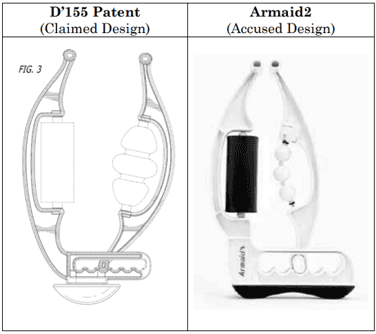
The district court’s decision—and the opinion on appeal affirming it—turned on a claim construction finding that much of the claimed design was functional, such as the clamshell shape of the arms advertised as providing leverage for the massage elements. Because any ornamental scope of the claim was held to be “narrow” and “plainly dissimilar” from the accused design, a majority of the panel comprising Judges Cunningham and Hughes found the district court properly granted summary judgment, with Judge Moore dissenting. Our write-up of that decision can be found here.
Now, with the majority of the en banc court denying rehearing, Judge Moore repeated and expanded on her arguments in dissent, this time joined by Judge Reyna. The dissent argued that it “defies belief to conclude that no reasonable jury could find the [above] patented and accused designs substantially similar in overall appearance,” invoking the “substantially the same” standard mandated by Gorham Mfg. Co. v. White, 81 U.S. 511, 528 (1871). In the dissenters’ view, the question should have been put to the jury, and the fact that it was not was a result of two related errors in the infringement standard applied by the Federal Circuit under Egyptian Goddess, Inc. v. Swisa, Inc., 543 F.3d 665 (Fed. Cir. 2008).
First, Judge Moore argued that disputed questions of functionality incident to claim construction should be decided by a jury, not a judge. She noted that in Markman v. Westview Instruments, Inc., 517 U.S. 370 (1996), the Supreme Court determined that judges should construe utility patent claims because “the construction of written instruments is one of those things that judges often do and are likely to do better than jurors unburdened by training in exegesis.” (Emphases supplied in dissent.) Judge Moore argued that by contrast, “[t]he entirety of a design patent is a series of pictures,” and that questions “like the functional-ornamental fact finding[] bear none of the hallmark indicia of judge advantage.” The dissent noted that “functionality” in other analyses—such as trade dress or trademark infringement—is a question generally left to the jury, and argued there is no reason it should not be the same for any question of functionality incident to assessing design patent infringement.
Second, Judge Moore took aim at a sentence from Egyptian Goddess, which provides that “[i]n some instances, the claimed designed and the accused design will be sufficiently distinct that it will be clear without more” that infringement cannot be found. The dissent argued that by focusing on whether the designs are “sufficiently distinct” instead of “substantially the same,” Egyptian Goddess “changed the frame of reference” and “inverted” the Supreme Court’s standard from Gorman. The dissent argued that this “exception has swallowed the rule,” such that district courts too often use it as a shortcut to dispose of what should be close cases, as the district court in this case disposed of Range of Motion’s claim. The dissent relatedly asserted that the accused and claimed designs should always be compared in view of the prior art, and never adjudicated as “plainly dissimilar” in a vacuum.
Meanwhile, Judges Cunningham and Hughes—the original panel majority—entered an opinion concurring in the denial of rehearing, and defending their original decision. The concurrence criticized the dissent for over-simplifying the design patent claim construction process, noting that it often involved more than determining functionality from pictures, and that it is always “the interpretation of a legal document and determining the bounds of a property right.” The concurrence argued that “[p]roviding an appropriate measure of guidance to a jury without… invading the jury’s fact-finding process is a task that trial courts are very much accustomed to,” and that subsidiary questions of functionality in design patent claim construction is no different from other subsidiary factual determinations left to the judge in construing legal instruments. Judges Cunningham and Hughes also dismissed the dissent’s “inverted standard” argument, noting that “[a]ssessing whether two designs are ‘substantially the same’ necessarily involves accounting for the ways in which they are similar and different.” They argued that this case was also a poor vehicle for en banc assessment of that argument, because the district court had performed an alternative three-way, “substantially similar” analysis in view of the prior art, had reached the same result, and the panel had affirmed on both grounds. As such, the concurrence explained that “[a]n en banc revision of the test as explained in Egyptian Goddess would have no impact on the ultimate outcome of Range of Motion,” further supporting their determination that any revisiting of that standard should wait for another day.
The order denying rehearing, and the judges’ concurring and dissenting opinions, can be found here.
By Jason A. Wrubleski
ALSO THIS WEEK
The Nielsen Company (US), LLC v. Tvision Insights, Inc., Appeal No. 2025-1371 (Fed. Cir. Aug. 14, 2026)
In an appeal from an inter partes review, The Federal Circuit affirmed the Patent Trial and Appeal Board’s determination that challenged claims of Nielsen’s U.S. Patent No. 11,470,243 were unpatentable as obvious over prior-art combinations including a reference authored by Ying-li Tian. The ’243 patent related to audience measurement technology; specifically, to an audience measurement device that uses a camera to capture images of an audience while identifying the media content being shown to audience members.
The PTAB found Tian to be analogous art under the “reasonably pertinent” prong of the analogous art inquiry, and the Federal Circuit held that finding to be supported by substantial evidence. Both the ’243 patent and Tian were directed to image processing and, more specifically, to facial detection and analysis. Tian’s methods for facial analysis on low-resolution images were found to share the same purpose as the challenged claims. The court rejected Nielsen’s attempt to narrow the relevant problem to reducing illumination-source use, noting the claims themselves were far broader and did not recite a light source, and that it would be inappropriate to travel outside the objective reach of the claim. On the merits, the panel affirmed the Board’s finding that Tian taught disputed claim limitations as supported by substantial evidence, as well as its finding of motivation to combine based on expert testimony, as opposed to a motivation supplied by the references themselves.
The full opinion affirming the PTAB’s determination can be found here.
By Jason Evans
Dental Monitoring SAS v. Align Technology, Inc., Appeal No. 2025-1752 (Fed. Cir. Aug. 10, 2026)
In an appeal from a final decision of obviousness by the US Patent Office in an inter parties review, the Federal Circuit vacated the Board’s decision of obviousness and remanded for further consideration of whether a provisional application corresponding to a relied-upon patent publication provided written description support for at least one claim of the publication. The patentee’s filing date fell between the provisional filing date and the actual filing date of the relied-upon patent publication. Although the Board established written description support for the relied-upon teachings of the patent publication, the Court held that that was not enough. The Board failed to also establish that the provisional application also provided written description support for at least one claim of the patent publication, which is a statutory requirement of AIA 35 USC § 102(d)(2). While it was not mentioned in the decision, it appears to this practitioner that the US patent office will likely need to update protocols used by patent Examiners, in view of this decision.
The opinion can be found here.
By Michael A. Cofield
This article summarizes aspects of the law and does not constitute legal advice. For legal advice with regard to your situation, you should contact an attorney.
Sign up