
Range of Motion Products, LLC v. Armaid Company Inc., Appeal No. 2023-2427 (Fed. Cir. Feb. 2, 2026)
The Federal Circuit’s only precedential decision this week was a rare case involving design patents. The Federal Circuit considered questions concerning infringement and claim construction in view of considerations of functionality.
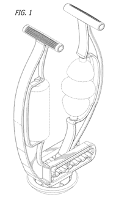
The patent in this case claimed an ornamental design for a massager as shown below.
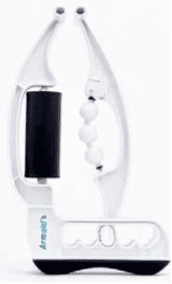
Range of Motion accused Armaid of infringing by selling its “Armaid2” product shown below:
The district court construed the patent to have a very narrow scope, finding that the majority of the design was dictated by function. The district court then granted summary judgment of non-infringement to Armaid. Range of Motion appealed.
The Federal Circuit first considered the district court’s claim construction opinion and agreed with the district court’s assessment that the claim’s scope was very narrow. The Court first explained its precedent when a design has both functional and non-functional elements, and a multi-part test it has used to evaluate whether a patent is “dictated by function.” Among the factors are:
whether the protected design represents the best design; whether alternative designs would adversely affect the utility of the specified article; whether there are any concomitant utility patents; whether the advertising touts particular features of the design as having specific utility; and whether there are any elements in the design or an overall appearance clearly not dictated by function.
Here, the district court found that the shape of the arms is functional. The district court considered language in a utility patent that concerned a prior Armaid massager. The district court also looked to Range of Motion’s marketing materials, which explained that the “clam-shaped roller arms provide significant leverage.” Based on this evidence, the district court held that the “clamshell” shape of the arms was functional, but that other details were ornamental. The Federal Circuit agreed.
Range of Motion argued that the drawing established that the clamshell shape was ornamental, given it was in solid lines instead of dotted lines. The Federal Circuit disagreed that whether elements are ornamental—as opposed to functional—should be determined solely by the drawings. Range of Motion also argued that Armaid’s own prior art design showed that there were alternative designs available. The Federal Circuit found that this factor did not outweigh the other factors.
Having concluded that the scope of the claims was narrow and excluded the clamshell shape of the arms, the Federal Circuit affirmed the finding of non-infringement. The district court observed that the two designs “at a conceptual level . . . look quite similar,” however, when the functional features were properly considered under applicable standards, the differences overwhelmed any similarities, identifying a number of differences between the designs. The Federal Circuit agreed: “We conclude that the district court did not commit reversible error in reaching its determination that the design of the Armaid2 and the narrow design protected by the D’155 patent are plainly dissimilar.” Having reached that conclusion, the district court did not need to engage in a three-way analysis involving comparison prior art. Nonetheless, the Federal Circuit affirmed the district court’s conclusion that, even using a three-way analysis, a finding of non-infringement was appropriate.
Chief Judge Moore issued a lengthy dissent, in which she urged the Court to reconsider the legal standard for design patent infringement en banc, believing the Court in Egyptian Goddess erred in adopting a “plainly dissimilar” standard as opposed to a “substantially similar” standard. The difference between focusing on the negatives (“plainly dissimilar” and focusing on the positives (“substantially similar”) skews the analysis, she argued.
The opinion can be found here.
By Nika Aldrich
This article summarizes aspects of the law and does not constitute legal advice. For legal advice with regard to your situation, you should contact an attorney.
Sign up