
Why is land in Washington so expensive, and why can’t I just build what I want on my property? We hear questions like this quite regularly. Land and land development are regulated in Washington by the “Growth Management Act.” The GMA’s primary purpose is to ensure cities and counties grow intentionally – in the locations and with the uses – that city and county staff intended. Cities and counties, therefore, decide in advance what can be done on every parcel of land in the state.
What Is the Growth Management Act?
Washington’s Growth Management Act (GMA) requires larger cities and counties to proactively manage population growth and urban development. The Legislature adopted the GMA in 1990. The law is codified in Chapter 36.70A RCW, though pieces can be found throughout other RCW chapters as well. The backbone of the GMA requires each participating city and county to develop and periodically update a “comprehensive plan” and “development regulations.” Disputes regarding these planning efforts are resolved by the Growth Management Hearings Board (GMHB). Appeals of GMHB decisions go to the Superior Courts in the various counties of the state.
Comprehensive Plans and the 15 Goals
A comprehensive plan is an extensive policy document that provides a long-term roadmap for economic, property, and resource development and management. A city’s comprehensive plan must be consistent with the county’s comprehensive plan.
A county or city comprehensive plan may consist of land use and development regulations, economic strategies, housing policies, and many other mechanisms meant to foster and regulate growth. The GMA lists fifteen planning goals meant to guide the development and adoption of comprehensive plans, in no particular order:
-
- Urban growth
- Reduce sprawl
- Transportation
- Housing
- Economic development
- Property rights
- Permits
- Natural resource industries
- Open space and recreation
- Environment
- Citizen participation and coordination
- Public facilities and services
- Historic preservation
- Climate change and resiliency
- Shorelines of the state.[1]
These broad goals inform the purpose and mission of the GMA; the substantive policy categories that each comprehensive plan must include are slightly different.[2] They include:
-
- A land use element
- A housing element
- A capital facilities plan element
- A utilities element
- A rural element (counties)
- A transportation element that is consistent with the land use element
- An economic development element
- A park and recreation element
- A climate change and resiliency element
There are also several optional categories that counties and cities may choose to analyze in their comprehensive plans, if they desire.[3]
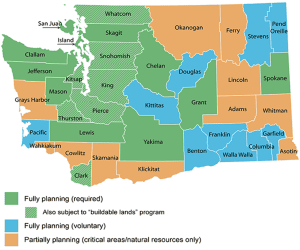
Is My County Fully or Partially Planning?
Counties which meet specific population criteria[4] or have voluntarily opted in[5], as well as most cities within those counties, are required to develop comprehensive plans under the GMA. Certain cities or towns with fewer than 500 people may opt out of full comprehensive plan review, even if located within a fully planning county.[6]
Of the 39 counties in Washington, 28 are required to fully participate in comprehensive planning—eighteen counties are required by meeting statutory criteria, while ten other counties have opted in. The eleven counties that are neither required to fully plan nor have opted in must still fulfill certain requirements under the GMA related to natural resource lands and critical areas that apply to every county.[7] These counties, and the cities within them, are designated as “partially planning.”[8]
Periodic Updates to Comprehensive Plans
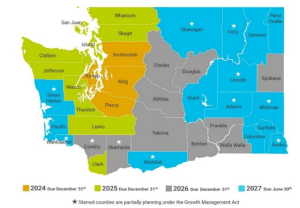
Under the GMA, cities and counties must subject their comprehensive plans and development regulations to “continuing review and evaluation.”[9] Each comprehensive plan must model and analyze a 20-year period starting from the time of its adoption.[10] A 2026 comprehensive plan, for example, should account for the period from 2026-2045. Even though the planning horizon for a comprehensive plan is 20 years, all fully planning cities and counties are required to conduct an extensive review of their comprehensive plans every ten years.[11]
Some counties completed their ten-year reviews in 2024 and 2025, but many of them received an extension to complete their reviews by June 2026. The remaining majority of counties are scheduled to complete their ten-year review in either 2026 or 2027. Partially planning counties, which do not maintain full comprehensive plans, must review their development regulations on similar timelines. The Washington Department of Commerce maintains a helpful interactive map on its website indicating when each county is due for review.[12] A static copy is provided below.
Growth Management Hearings Board
The GMHB is a five-member body that sits within the larger Environmental and Land Use Hearings Office (ELUHO).[13] The GMHB hears and decides claims that a fully planning city, county, or state agency has failed to comply with requirements of the GMA or some provisions of the Shoreline Management Act or State Environmental Policy Act.[14] Stated most simply, the matters that the GMHB is allowed to consider are challenges to the adoption or amendment of comprehensive plans or development regulations. There used to be several regional GMHB panels. Now, there are three: the Central Puget Sound Region (King, Kitsap, Pierce, and Snohomish Counties), the Western Washington Region, and the Eastern Washington Region.[15]. A list of decisions currently pending before the GMHB can be found using the ELUHO Case Search Tool[16], selecting only GMHB cases and filtering by “Open Cases Only.”
This article is intended for general informational purposes and does not constitute legal advice. For guidance on your specific situation, consult qualified employment counsel.
[1] RCW 36.70A.020.
[2] RCW 36.70A.070.
[3] RCW 36.70A.080.
[4] RCW 36.70A.040(1).
[5] RCW 36.70A.040(2).
[6] RCW 36.70A.130(b).
[7] RCW 36.70A.170.
[8] RCW 36.70A.060(1)(c).
[9] RCW 36.70A.130(1)(a).
[10] WAC 365-196-400(2)(a).
[11] RCW 36.70A.130(4)-(5).
[12] https://www.commerce.wa.gov/growth-management/gma-topics/periodic-update/
[13] RCW 36.70A.250.
[14] RCW 36.70A.280(1)(a).
[15] WAC 242-03-015
[16] https://eluho2022.my.site.com/casemanager/s/case-search
Sign up