The Bottom Line
For Department of Defense sole-source 8(a) awards, the value above which a DoD justification and approval (J&A) is required is $100 million, not $150 million.
On July 24, 2026, DoD issued Revision 1 to Class Deviation 2026-O0037, which expressly corrects DFARS 219.208-2 from $150 million to $100 million, effective immediately. This supersedes guidance that circulated during the spring and early summer of 2026, including from SBA field offices and at industry conferences, that DoD could award sole-source 8(a) contracts up to $150 million with no J&A.
If your company is pursuing, has been offered, or was awarded a DoD sole-source 8(a) contract valued between $100 million and $150 million at any point since February 1, 2026, please review the “What You Should Do Now” section below and contact us.
How the Confusion Arose
The $150 million figure never came from a statute or a notice-and-comment rule. It came from the original Revolutionary FAR Overhaul (RFO) class deviation for DFARS Part 219, issued January 21, 2026, and effective February 1, 2026. The deviated text of DFARS 219.208-2 stated that SBA could not accept a DoD sole-source 8(a) contract exceeding $150 million for negotiation unless DoD had completed a justification. Because the deviation directed contracting officers to use that text “in lieu of” the codified DFARS, SBA headquarters counsel and several district offices treated $150 million as the operative acceptance threshold and told participants that DoD sole-source offerings up to that amount could be accepted without a J&A.
That reading was always in tension with the rest of the framework:
- Section 823 of the FY2020 NDAA, the codified DFARS 206.303-1 and 219.808-1, and the RFO’s own DFARS 206.104-70 (the very provision that 219.208-2 cross-references) all set the no-J&A ceiling at $100 million.
- In its August 2025 DFARS inflation-adjustment final rule (90 Fed. Reg. 41483), DoD expressly declined to escalate the DFARS 206.303-1 and 219.808 thresholds to $150 million because they fell short of the statutory adjustment formula in 41 U.S.C. § 1908.
- The only $150 million figure in the regulations is in the J&A approval tiers formerly at FAR 6.304, which govern who must sign a DoD J&A once one is required. That tier was likely the source of the drafting error in the January deviation.
Revision 1 resolves the inconsistency the only way it plausibly could: by conforming 219.208-2 to the $100 million ceiling everywhere else in the FAR and DFARS. DoD’s memorandum lists the change as a “correction,” confirming the $150 million text was a drafting error rather than a policy decision.
The Rule Today
Revised DFARS 219.208-2 now reads: “In lieu of the threshold at FAR 19.208-2(a), the SBA may not accept for negotiation a DoD sole-source 8(a) contract that exceeds $100 million unless the DoD has completed a justification in accordance with the requirements of FAR 6.104 and 206.104-70.” Read together with DFARS 206.104-70 and the J&A approval tiers, the DoD sole-source 8(a) landscape is:
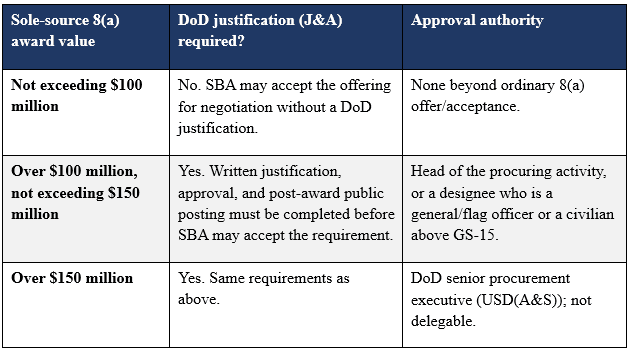
Two points worth emphasizing. First, a J&A above $100 million is not an obstacle to award; it is an internal DoD approval step that the contracting officer must complete before SBA accepts the requirement. Second, the $100 million to $150 million band still carries a real advantage: the J&A can be approved at the head-of-contracting-activity level rather than by the Under Secretary, which materially shortens the approval path compared with awards above $150 million.
Other Changes in Revision 1
Beyond the threshold correction, Revision 1 replaces the entire January deviation package for DFARS Part 219, PGI 219, and Appendix I (Mentor-Protégé). Changes relevant to ANC, tribal, and NHO contractors include:
- Subcontracting plan reporting now runs through the new SAM.gov Subcontracting Plan Reporting system; the eSRS was decommissioned on February 20, 2026, and the DoD deviation clauses at 252.219-7996 and 252.219-7997 were revised accordingly.
- New DFARS 219.106-70 governs verification of SDVOSB eligibility in lieu of FAR 19.106-1(b) and (c)(2) until SAM.gov aligns with FAR procedures; the revision also supersedes Class Deviation 2024-O0002, Rev. 1.
- Section and clause numbering has been reorganized (for example, the Partnership Agreement procedures now sit at 219.208-70). Proposal templates and compliance checklists that cite the January numbering should be updated.
Points to Consider
Every procurement is different, and the appropriate response will depend on a company’s particular contracts and circumstances. With that in mind, 8(a) participants pursuing DoD sole-source work may wish to consider the following:
- Internal guidance built on a $150 million figure. Capture plans, pricing strategies, or compliance materials prepared on the assumption that DoD sole-source 8(a) awards up to $150 million require no J&A may warrant a second look in light of Revision 1.
- Awards and offerings in the $100 million to $150 million range between February 1 and July 24, 2026. Companies that received, or were in process on, DoD sole-source 8(a) awards in that range while the original deviation was in effect may consider confirming with the contracting officer whether a justification was completed, and gathering the record showing the basis on which the award was made. Given the attention large sole-source 8(a) awards currently receive, having that documentation in hand may be useful if questions arise later.
- SBA district office acceptance posture. Some SBA field offices communicated the $150 million position in writing during the spring. Participants relying on an SBA acceptance issued on that basis may consider raising the July 24 correction with their Business Opportunity Specialist.
- Planning for the J&A step on larger requirements. For requirements expected to exceed $100 million, companies may find it helpful to discuss the justification process with the contracting officer early and to understand which official will approve it (head of the procuring activity level up to $150 million; USD(A&S) above that), so the step can be built into the acquisition timeline.
- The class deviation remains in effect until DoD incorporates it into the DFARS through rulemaking. We anticipate a DFARS case later this year and will circulate an update when one is published.
This article summarizes aspects of the law and does not constitute legal advice. For legal advice for your situation, you should contact an attorney.
Sign up