The SBA has published the FY 2025 Small Business Procurement Scorecard. The federal government again earned an overall grade of “A” (104.72%) and reported that it exceeded its prime small-business goal. However, the most consequential development is not the grade — it is how the Scorecard newly characterizes tribal-entity 8(a) participation.
On its FY 2025 8(a) Awards page, the Scorecard states: “Tribal entity-owned firms are 16% of participants — yet receive nearly 70% of 8(a) dollars.” The word “yet” frames a lawful, congressionally authorized outcome as though it were an anomaly to be questioned. Given the current enforcement environment surrounding the 8(a) program, that framing should be on every ANC, tribal, and NHO leadership team’s radar.
This update summarizes the relevant Scorecard data, flags why the framing is concerning, highlights the separately-issued Department of Defense (referred to by the SBA as the Department of Defense) agency detail, and places the figures against our multi-year analysis of federal 8(a) spending.
The “Yet”: How SBA Now Frames Tribal-Entity 8(a) Dollars
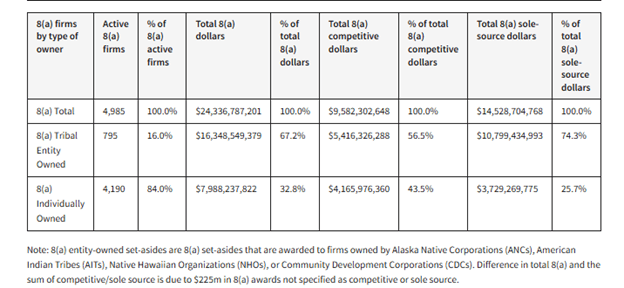
The Scorecard’s 8(a) Awards page presents two charts (share of active firms and award dollars by competition type) above the headline sentence. The underlying data table reports the following for FY 2025:
| 8(a) firms by owner type | Active firms | % of firms | Total 8(a) $ | % of 8(a) $ |
| 8(a) total | 4,985 | 100.0% | $24.34B | 100.0% |
| Tribal Entity Owned (ANC, AIT, NHO, CDC) | 795 | 16.0% | $16.35B | 67.2% |
| Individually Owned | 4,190 | 84.0% | $7.99B | 32.8% |
The SBA frames this data in charts to emphasize the share of 8(a) spend realized by Native entities:
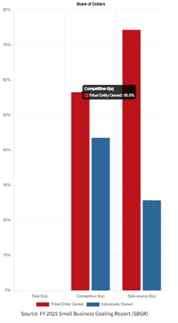
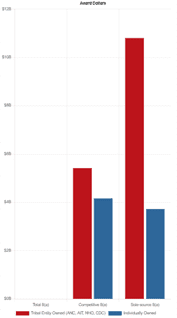
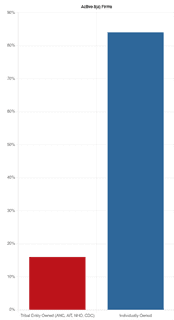
Source: FY 2025 Small Business Goaling Report (SBGR), as presented on the SBA Scorecard.
Why the framing is concerning
The “yet” presents a feature of the program as if it were a defect. The concentration of dollars in tribal-entity firms is the direct, intended result of authority Congress granted, and SBA codified — principally the sole-source authority for ANC-, tribe-, and NHO-owned firms under 13 C.F.R. § 124.506(b). It reflects Congress’s policy choice to use federal procurement as a vehicle for Native economic self-determination, not an exploited loophole.
Presenting the statistic in the language of imbalance, on an official government scorecard, during a period of active program challenges, supplies rhetorical material to critics and litigants. It is the kind of framing that can migrate from a data page into a congressional talking point or a complaint.
The number behind the “yet”
The per-firm math is the part the headline omits. Tribal-entity firms averaged roughly $20.6M each in FY 2025 8(a) dollars; individually-owned firms averaged about $1.9M each — an ~11x difference. That gap is not evidence of misuse; it reflects that ANC/tribe/NHO firms are purpose-built to take on the large, sole-source-eligible work that the program’s structure contemplates. The “16% / 70%” split is a function of award size and authority, not preferential treatment per contract.
Source: FY 2025 Small Business Goaling Report (SBGR), as presented on the SBA Scorecard.
Sole-Source vs. Competitive: Where the Concentration Actually Sits
The Scorecard’s set-aside table shows that 8(a) is unique among the major set-aside categories in its reliance on sole-source awards. Of $24.34B in total FY 2025 8(a) obligations, $14.53B (about 60%) was sole-source and $9.58B (about 39%) was competitive. By contrast, SDVOSB, WOSB, and HUBZone are each 94–98% competitive.
| Set-aside category | Set-aside $ | Competitive $ | Competitive % | Sole-source $ |
| Small Business | $71.75B | $71.75B | 100.0% | N/A |
| SDVOSB | $14.34B | $13.97B | 97.4% | $0.38B |
| WOSB | $1.98B | $1.86B | 94.0% | $0.12B |
| HUBZone | $2.91B | $2.84B | 97.6% | $0.07B |
| 8(a) | $24.34B | $9.58B | 39.4% | $14.53B |
Source: FY 2025 Small Business Goaling Report (SBGR), as presented on the SBA Scorecard.
Practical takeaway: the sole-source authority is doing exactly what Congress intended, and it is the mechanism most exposed to policy and litigation risk.
Department of Defense (Referred to as Department of War): Agency Detail
The FY 2025 Scorecard for the Department of Defense refers to the Department of Defense as the Department of War (DOW). DOD is, by a wide margin, the single largest source of 8(a) dollars, and the agency whose procurement posture most determines the health of the entire program.
| Department of Defense — FY 2025 Scorecard | Result |
| Overall grade | A (100.46%) |
| Prime contracting achievement | 54.01% of eligible dollars to small business |
| Small Business prime (goal 23%) | Achieved ~32.7% |
| Small Disadvantaged Business (goal 5%) | Achieved ~10.1% |
| Subcontracting achievement | 18.64% |
| 15(k) OSDBU compliance | 17.82% (score 19.6) |
| Small business prime contractor count | FY24 ~29,500 → FY25 ~28,900 (down ~2%) |
Two points. First, DOD comfortably exceeded its small-disadvantaged-business goal (~10.1% against a 5% target), and 8(a) is the primary engine of SDB attainment. This means DOD has a structural incentive to keep awarding 8(a) work, including to tribal-entity firms, because it would not otherwise be significantly exceeding its SDB goal. Second, the small decline in DOD’s small-business prime contractor count (~2%) is consistent with the broader FY 2025 contraction we are tracking and bears watching into FY 2026.
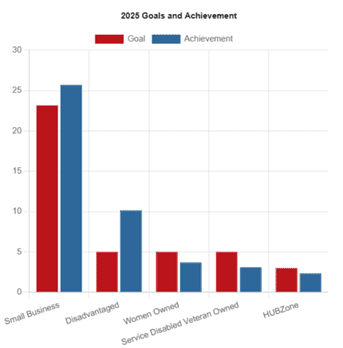
Overall, the scorecard shows that DOD procurements continue to be the largest driver of 8(a) and small business contracting goals, and the DOD continued to exceed its SDV goal for 2025.
This article summarizes aspects of the law and contains opinions that are solely those of the authors. This article does not constitute legal advice. For legal advice regarding your situation, you should contact an attorney.
Sign up